
Author – Spencer Turkal
In this article I will explain both how to calculate SBP premiums as well as how to determine whether you should elect it (if you already know how to calculate SBP premiums feel free to scroll past the first section below). Firstly, what is SBP? SBP stands for Survivor Benefit Program. It is the option for a spouse, former spouse or dependent child to receive a portion of the retiree’s pension payments each month after the retiree passes away. It is automatically elected for retiring service members and the spouse’s signature is required in order to not elect it. See, if there was no such thing as SBP and a military retiree passed away then that pension that he or she worked very hard for would stop paying out and their family would presumably be left without much financial support (if they had not properly planned). With SBP retirees can elect to have their spouse or children receive up to 55% of their retired pay each month until their spouse passes away, or in the case of children, when they turn 18 or are in a full-time course of study and turn 22. In this way, the SBP benefit acts much like an annuity for the surviving spouse. This article will focus mostly on spouse only SBP for simplicity but will link to the official DoD site at the bottom for more information.
How do I calculate how much SBP will cost?
Now that we know what SBP is, the first thing you may actually ask is: well, what the heck does SBP cost? (I’ll Leave what expletive you want to use up to you.) Often, we find service members receive insufficient information during their transition course to make an informed decision. Luckily, the formula to figure out the monthly cost (also referred to as the monthly premium) is super simple (we will focus on the spouse only coverage as the child coverage is a little more complicated and rather inexpensive comparatively). First, find out what your monthly base pay is, so for example, let’s take a LtCol retiring after 20 years on the High-36 Plan that has an average final pay across 36 months of $127,632. The calculation would be:
($127,632 * 20 * 0.025) / 12 = $5,318
(Average Pay * Years of service * Multiplier) / (12 months) = Monthly Retirement Pay
Great, now we know that in our example that the base retirement pay is $5,318. Now how do we calculate the monthly cost/premium of SBP? Let’s take a look:
$5,318 * 0.065 = $345.67
Monthly Retirement Pay * 0.065 = Monthly SBP Premium
That’s it. Just multiply your base retirement pay by 0.065 and that is how much full SBP will cost for you. “Is that all?” you may ask. No not really, there are a couple other aspects of SBP that are important to understand before we can decide whether to decline electing it.
- The cost of SBP is deducted from your retirement pay before taxes. Meaning you do not have to pay taxes on the amount that you pay for SBP. You could also think of this as a percentage discount equal to whatever your effective tax rate is in any given year.
- You only need to pay for SBP for 30 years and until you are 70 (sorry retirees under 40). Put another way, you must pay for SBP for 30 years, unless after 30 years you are still under 70 in which case you would continue paying until you are 70.
- In addition to point number 2, if the retiree passes away, the SBP cost goes away and the benefit begins paying the spouse.
- If the spouse passes away before the retiree, SBP premiums will stop and the coverage will go away (unless you also elected child coverage and have a minor child). However, any premiums already paid will not be recouped.
- The cost of SBP rises with cost-of-living adjustments, the same as a military pension.
- The base amount used for SBP does not need to be your full pension like in the example. It can be anywhere between $300 and your full monthly pension amount. Meaning that you can lower both the benefit and premium per month all the way down to $300 per month of benefit and $19.50 per month of premium.
- If you joined the military before March 1, 1990, your cost formula may be slightly different.
Okay, now I know how to calculate SBP. Just tell me if I should elect it.
Just like anything else, whether to elect SBP comes down to an analysis of cost and the comfort level between strategies. First drill down to what is important to you personally. There a plenty of factors to consider but as a quick exercise, pick your 3 highest priorities from the following list:
- I want to make sure my spouse has guaranteed income to cover their bills each month in the event of my passing.
- I want to make sure my spouse has a lumpsum amount to be able to pay off any debt such as a mortgage, auto loans, children’s student loans, etc.
- Even if I passed away in my 70s/80s, I would want my wife to get a portion of my pension since I worked hard for it.
- While I want my spouse to be taken care of if I pass away, I do not want to sacrifice more resources than we have to, while I am living.
- Once my spouse and I are financially stable and have enough saved for goals/retirement I don’t really need SBP anymore and wouldn’t want to pay for it at that point.
- I would like finances to be as simple as possible for my spouse in the event of my passing.
While we can’t give recommendations in this article, with our clients we find those that would pick options 1, 3 and 6 often decide that full SBP is their best bet, those that would pick options 2, 4 and 5 may want to forgo SBP and instead opt for a term life insurance policy and those that pick some other combination may be most comfortable with a combination of term life insurance and SBP. The best path to deciding is a team approach with the help of a fee-only financial advisor
The next step would be to figure out your total coverage need but for the sake of this article, let’s skip that and simply make a quick comparison between some life insurance quotes and SBP (in other words, I wrote a big, long confusing example scenario and afterwards realized that it distracts from the point of this article and deleted it. In the future I will write an article on how to calculate insurable needs). I am going to use an insurance company that is commonly used among our clients for quotes because they are easy to get quotes from and have prices conducive to what we typically see, but we are indifferent on the company as long as they are 1. Reputable/financially strong and 2. cheaper than other companies.
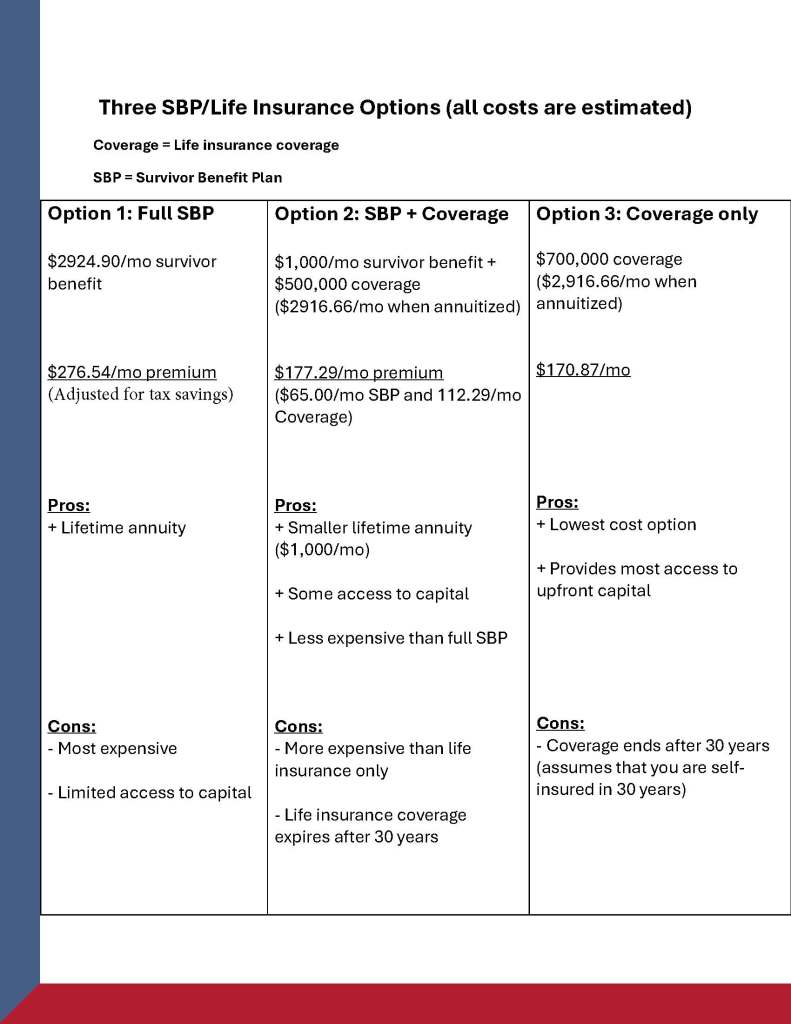
(I am told that this paragraph and the next one are “boring” and “too in the weeds” so feel free to just reference the chart above and skip this paragraph as well as the next one.) For our earlier example, full SBP would have cost $345.67 per month and would provide a benefit that is 55% of the full monthly retirement benefit. That SBP benefit would be about $2,924.90 per month for the life of the spouse. Since SBP premiums are deducted before taxes, let’s say this individual typically has a combined state and federal effective tax rate of 20%. This would mean that the comparative cost (when compared to life insurance) would be about $276.54 per month after tax savings. Let’s now convert the benefit to a lump sum so that we can compare it to life insurance (to do this you can multiply the monthly SBP benefit by 12 to get the annual amount and then divide it by anywhere between 0.03-0.08. For the sake of this article we will divide it by 0.05. This very roughly calculates how much an annuity to create the same benefit would cost). This would result in a total lumpsum benefit value of about $701,976 (Keep in mind that the total benefit is received monthly and not in a lump sum, so it would be less flexible).
For the life insurance quote, I made our example service member a 5’10”, 190-pound, non-tobacco using, 42-year-old with “average” health and gathered a quote for $700,000 of coverage. For a 30-year term the monthly quote was $170.87 per month. Keep in mind that these premiums and benefits stay the same over the life of the policy whereas the premiums and benefits for the SBP increase with the rate of inflation. Also understand that one of the benefits of SBP is that it is available even after 30 years if you complete all the premiums, but a term policy will expire. The strategy with the term is that you will have built enough savings to “self-insure” once the term expires.
This lines up with what we typically see, Term insurance is cheaper for relatively the same amount of coverage however, that coverage is structured a bit differently and comes with its own disadvantages. The Term provides flexibility in the case of an early death but nothing after it ends. SBP provides guaranteed income for the spouse but lacks flexibility.
Of course, there are many other factors that go into your choice but that is again why it is good to consult with a financial advisor. Did you know Sierra Hotel Financial offers to build complimentary financial plans for all active-duty military and military veterans? Contact us. https://sierrahotelfinancial.com/contact/
For more information, please check out: https://militarypay.defense.gov/Benefits/Survivor-Benefit-Program/Costs-and-Benefits/